
Gel-Pak to Exhibit at SWTest Asia 2026 in Taiwan
How TXF textured film creates configurable fixturing surfaces for assembly and advanced die bonding
TECHNICAL FOCUS
Temporary retention | ESD-safe work surfaces | Pocketless die placement | Direct device access
Gel-Pak is widely used to hold, protect, and transport delicate components. TXF textured film extends that function into manufacturing by creating a temporary interface between the component and the process. When TXF is laminated to a workstation or rigid tool surface, the surface itself becomes a fixture for assembly, alignment, bonding, inspection, or transfer.
Two production applications illustrate the range of this approach: a large-scale ESD-safe workstation deployment for manual electronics assembly and a 300 mm substrate chuck for precision die-to-die bonding.
A Surface-Level Approach to Fixturing
Conventional fixturing often relies on trays, machined pockets, clips, vacuum features, or release films. Each method can be effective, but it can also add geometry constraints, infrastructure, handling steps, or a release-activation requirement.
TXF provides a continuous microtextured surface for temporary component retention. Because the retention function is integrated into the contact surface, components remain accessible from above and around the perimeter. The underlying workstation, plate, or chuck continues to provide the structural and equipment interface.
Application 1: ESD-Safe Workstation Fixturing
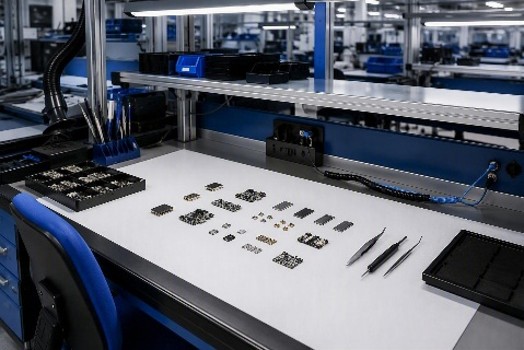
A manufacturer of avionics and consumer wearable electronics needed a consistent surface for manual assembly of small, fragile components. The production environment included 300 workstations, with 50 stations per floor.
An ESD-safe bench addressed static-control requirements, but a flat work surface did not inherently prevent miniature components from shifting. Separate trays or part-specific nests would reduce the open assembly area and introduce additional handling.
The manufacturer laminated TXF directly to each workstation. The microtextured, ESD-safe film created a broad fixture area that helped retain components at the point of work while preserving access for manual assembly. TXF was supplied in 18-inch-wide, 300-foot-long rolls to support standardized installation across the operation. When the working surface required renewal, the film could be replaced.
Engineering result: The workstation became a scalable, replaceable fixturing surface that combined ESD-safe handling with component stabilization.
Application 2: Configurable 300 mm Die-Bonding Chuck
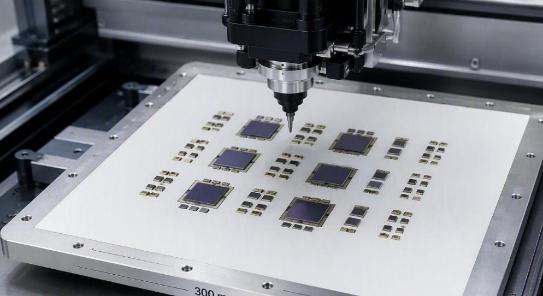
In an advanced die-bonding application, the customer needed to pre-orient die for a multi-chip module and maintain X-Y position and rotational orientation through stage movement, optical alignment, and bonding.
The fixture had to combine a flat, rigid equipment interface with secure temporary retention, clear optical access, and direct removal for the next process step. Vacuum micro-grooves required vacuum infrastructure and compatible contact geometry. Machined pockets were tied to a defined device geometry and module layout. UV-release and thermal-release films required a separate activation step before removal.
The customer laminated TXF onto a rigid 300 mm aluminum plate. This separated the fixture into two functional layers:
- Rigid aluminum chuck: provides the machine interface, planar support, and dimensional stability.
- TXF textured film: provides a configurable, pocketless surface for die placement and temporary retention.
The continuous surface supported multiple die sizes and layouts without pocket walls, clips, or vacuum grooves. It also preserved the field of view required for optical alignment and allowed direct pick-and-place removal after bonding, without a dedicated UV or thermal deactivation cycle.
Engineering result: TXF converted a standard 300 mm plate into a configurable temporary fixture connecting die pre-orientation, alignment, bonding, and downstream transfer.
One Technology, Two Manufacturing Interfaces
The two applications differ in scale and process precision, but the architecture is consistent. A rigid workstation or tool provides structural support. TXF provides the device-contact and retention surface.
| Design consideration | Workstation application | Die-bonding application |
|---|---|---|
| Base interface | Assembly workstation | Rigid 300 mm aluminum chuck |
| TXF function | ESD-safe component stabilization | Pocketless temporary die retention |
| Process access | Open manual assembly area | Optical, top, and side access |
| Deployment benefit | Standardized, replaceable coverage | Configurable die layouts and direct removal |
Designing the Interface Around the Device
These applications expand the role of Gel-Pak beyond transport and storage. TXF can function as a process-enabling surface wherever a manufacturer needs temporary retention while preserving access to the component.
For process engineers, the design question is not only how to carry the device. It is also how the device should interface with the workstation or equipment during the operation. A surface-based fixture can reduce dependence on part-specific nests and integrate retention into an existing manufacturing surface.
Potential application areas
- Manual assembly of small or fragile components
- Advanced packaging and heterogeneous integration
- Die-to-die bonding and multi-chip module assembly
- Temporary fixturing for alignment or inspection
- Process development and new-product introduction
- Automated pick-and-place and transfer workflows
Conclusion
TXF textured film gives manufacturers a practical way to integrate temporary retention into the manufacturing surface. In one application, TXF turned 300 workstations into standardized ESD-safe fixture areas. In another, it turned a rigid 300 mm plate into a configurable die-bonding chuck. Both demonstrate the same principle: the contact surface can be engineered as an active manufacturing interface, not simply a place to set or transport a device.
Discuss Your Application
Contact Gel-Pak to evaluate how TXF textured film could be integrated into your workstation, fixture, or equipment interface.